
Why Promising Peptides Will Never Be “Proven” — The Hidden Economics Behind Therapies Your Doctor Can’t Recommend
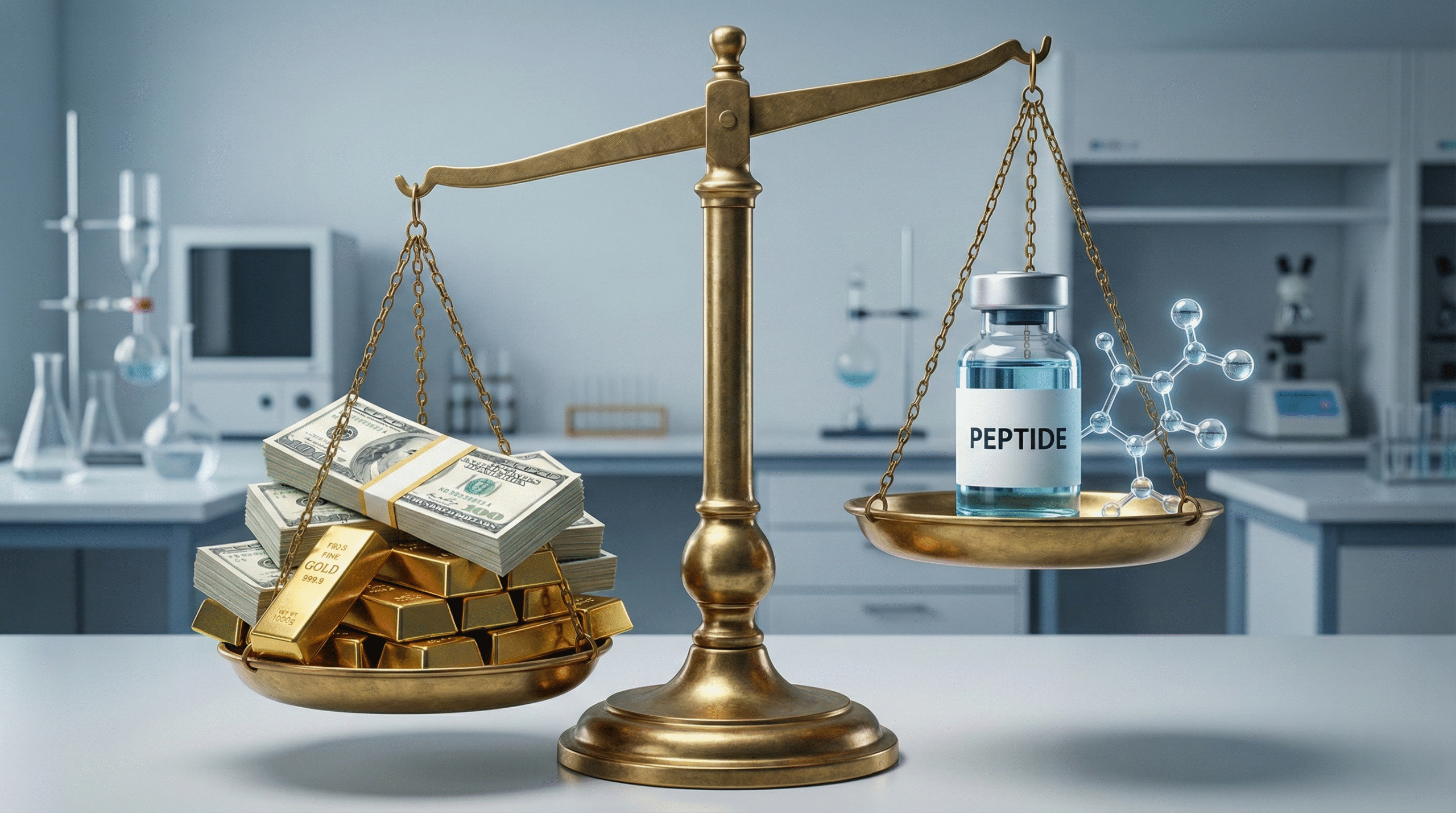
“My doctor said there’s no evidence. But I found hundreds of studies. What am I missing?”
It’s a question I hear constantly — from patients exploring peptides like BPC-157 or thymosin alpha-1. They’ve done their research. They’ve found animal studies, mechanistic data, even small human trials. And yet their physicians dismiss these therapies with a single phrase: “There’s no evidence.”
Consider a man I’ll call Robert — 62 years old, chronic Achilles tendinopathy, failed physical therapy, failed cortisone injections, facing surgical repair. He reads about BPC-157, a naturally occurring peptide with a large body of preclinical research since the 1990s showing tissue-healing effects in animal and in-vitro models. He asks his orthopedist.
“I can’t recommend that. It’s not FDA-approved. There’s no evidence.”
Robert tries it anyway — sources it himself, injects it himself, and eight weeks later, his pain is gone. No surgery.
He’s grateful. But he’s also angry. Why couldn’t anyone guide him? Why did he have to navigate this alone? And what, exactly, did his doctor mean by “no evidence”?
Robert’s experience reveals something deeper than a gap in medical research. It reveals a fundamental asymmetry in how patients are permitted to make choices about their own bodies.
Known Harm vs. Unknown Risk: Who Decides?
Every FDA-approved drug comes with known side effects—sometimes severe. Statins can cause muscle damage. Blood thinners can cause fatal bleeding. Antidepressants carry black box warnings for suicidal ideation. Opioids carry risks of addiction and death.
Patients accept these known harms every day because they—together with their doctors—determine that the benefits outweigh the risks for their situation.
This is informed consent. It is the foundation of patient autonomy.
Yet when a therapy’s risks are unknown rather than known to be harmful, the system responds differently. The absence of large-scale safety data becomes grounds for dismissal, prohibition, or silence.
The asymmetry is striking:
| FDA-Approved Drugs | Unapproved Peptides | |
| Benefits | Documented | Plausible, emerging |
| Risks | Known, often serious | Unknown at scale |
| Patient choice | Permitted | Discouraged or unavailable |
A patient can choose a drug known to cause liver toxicity. But that same patient is told they cannot reasonably choose a peptide whose risks are simply unstudied.
The Monitoring Objection
A reasonable counterargument: known risks can be anticipated and monitored. If we know a drug causes liver toxicity, we can check liver enzymes. Unknown risks offer no such roadmap.
This is true — but only partially.
Patients using any therapy can be monitored for general signals of harm: liver function, kidney function, inflammatory markers, blood counts, symptoms. Specific screening requires specific knowledge, but vigilant clinical monitoring does not.
Moreover, many “known” risks were not known at approval. They emerged through post-market surveillance — sometimes after millions of patients were exposed. Vioxx’s cardiovascular risk. Avandia’s cardiac signal. Zantac’s carcinogen concerns. The opioid crisis itself. Phase 3 trials establish a regulatory threshold; they do not guarantee safety.
And patients already accept unquantified risk routinely — through off-label prescriptions, supplements, surgical variability, and lifestyle choices. The notion that all risk must be fully characterized before a patient may choose is not how medicine actually operates.
The asymmetry remains: patients may accept serious, documented risks — but not unstudied ones. The distinction is not safety. It is documentation. And the documentation is missing because it was never economically viable to produce.
The question is not whether large-scale trials have value. They do. The question is: Who decides what level of uncertainty a patient may accept?
If the answer is “not the patient,” then the system has moved from protection to paternalism—substituting institutional risk tolerance for individual judgment.
Patients are not asking for recklessness. They are asking for the same respect granted when the risks are known: the right to weigh evidence, consult their physicians, and decide for themselves.
But why does this asymmetry exist? Why are so many promising therapies left unstudied — forcing patients like Robert to navigate alone?
The answer is economics.
The True Cost of “Proof”
Bringing a drug from concept to FDA approval is a long, expensive process:
| Phase | Purpose | Typical Cost | Timeline |
| Preclinical | Safety in animals, mechanism | $2–5 million | 1–3 years |
| Phase 1 | Human safety, dosing | $10–15 million | 1–2 years |
| Phase 2 | Efficacy, side effects | $20–50 million | 2–3 years |
| Phase 3 | Large-scale efficacy, comparison | $100–300+ million | 3–5 years |
| FDA Approval | Review, manufacturing | $50–100 million | 1–2 years |
Total: $500 million to $2 billion per drug, over 10–15 years.
Published analyses from the Tufts Center for the Study of Drug Development estimate average drug development costs at approximately $1.4 billion out-of-pocket and $2.6 billion when accounting for capital costs and failure rates.
This system was designed to prevent harm at scale—and it succeeds at that goal. But it also assumes something critical: that the drug being tested will eventually generate monopoly-level returns.
Without that assumption, the system collapses.
Why Peptides Don’t Get Funded
- The Patent Problem
Many naturally occurring peptides—such as BPC-157 or thymosin alpha-1 — exist in nature. That means they generally cannot be patented in their native form.
A weak patent position can mean:
- Limited ability to block competitors beyond FDA statutory exclusivity (which varies by product and circumstance)
- A smaller “moat” once exclusivity ends, because competitors can often enter faster when there are no robust patents to litigate around
- A harder ROI case for funding large, expensive trials
FDA exclusivity can range from months to years depending on the situation and operates separately from patents. But without strong patent protection extending beyond those windows, the long-term commercial protection remains uncertain.
Why would a pharmaceutical company spend hundreds of millions proving a compound works if its long-term commercial protection is uncertain, and competitors can prepare to enter quickly once statutory exclusivity ends?
In most cases, they wouldn’t—and they don’t.
- The Short Patent Window
Even when companies attempt to patent a delivery method or minor modification, the patent clock starts ticking at filing—not at approval.
Drug patents typically last 20 years from the filing date. But by the time clinical trials and FDA review are complete, a substantial portion of the nominal patent term may already be consumed, leaving a much shorter effective market-protection window after approval.
Generic competition can then erode margins rapidly, diminishing the economic incentive before Phase 3 ever begins.
- No Pharmaceutical Champion
Large trials are not funded by curiosity; they’re funded by expected returns.
Phase 3 trials typically require a corporate sponsor anticipating a 10–20× return on investment. Naturally occurring peptides, which cannot be easily monopolized, fail this test.
Academic grants are too small to fund large human trials. Public funding rarely advances beyond Phase 2. Hybrid regulatory pathways such as the FDA’s 505(b)(2) process—which allows applicants to rely on published literature or FDA’s prior findings of safety and efficacy—can sometimes reduce development burden, but they still require substantial capital and a sponsor willing to assume financial risk. Without a commercial champion, the research simply stalls.
- A Regulatory Framework Built for Blockbusters
The FDA approval pathway is optimized for:
- Novel, patentable molecules
- Large pharmaceutical sponsors
- Blockbuster economics
There is no streamlined regulatory pathway for compounds with:
- Long informal safety histories
- Strong mechanistic rationale
- Limited commercial upside
This isn’t malicious—it’s structural. A system designed to regulate mass-market drugs is poorly suited to evaluate low-profit therapies, even when they show promise.
The Catch-22 of “No Evidence”
The result is a self-reinforcing loop:
- “There’s no high-quality human evidence.”
- Why not? “No one funded the trials.”
- Why didn’t anyone fund them? “They aren’t easily monopolized.”
- Why does that matter? “There’s no profit incentive.”
Absence of Phase 3 trials is then mistaken for absence of merit—when in reality, it often reflects absence of financial viability.
Scientific merit matters—but only after economic feasibility is secured.
What Gets Funded Instead
Predictably, the system favors:
- Patentable synthetic analogs of natural compounds
- Novel molecules that can be exclusively owned
- Drugs with billion-dollar annual revenue potential
Scientific promise matters—but only after economic viability is established.
Why Some Peptides Made It Through
Not all peptides are excluded from the approval process. Insulin, semaglutide, and tirzepatide have achieved FDA approval and blockbuster success.
The difference is not scientific merit—it’s structural advantage.
These peptides were modified enough from their natural forms to be patentable. Semaglutide isn’t natural GLP-1—it’s a proprietary analog with amino acid substitutions and a C18 fatty-diacid side chain that extends its half-life from minutes to approximately one week, enabling weekly dosing. That modification is what Novo Nordisk owns.
They also address massive, chronic markets—diabetes, obesity—requiring ongoing treatment for life. And their manufacturing complexity creates barriers that protect market share even after patents weaken.
Natural peptides like BPC-157 or lunasin offer none of these advantages. They can’t be meaningfully patented in native form. They’re relatively easy to synthesize. Their applications are broad but diffuse.
And so they remain unstudied at scale—not because they failed, but because they were never viable candidates for a system that requires ownership as the price of proof.
The Irony of Peptides Like BPC-157
Some peptides have:
- Decades of preclinical research
- Plausible and increasingly mapped mechanisms
- Widespread clinical and anecdotal interest
- Signals of benefit across multiple tissue types
BPC-157, for example, has a large body of published preclinical literature since the 1990s examining effects on gut healing, tendon repair, inflammation, and neuroprotection in animal and in-vitro models. It is not FDA-approved for human use and is often marketed as a research compound. FDA has listed BPC-157 among substances that may present significant safety risks when compounded, citing concerns including immunogenicity, peptide impurities, and limited safety information.
Thymosin alpha-1 (thymalfasin) has been approved or marketed in numerous countries for hepatitis B/C and as an immune adjuvant in certain contexts—though reported approvals vary by source, and FDA notes it cannot independently verify all country-approval claims. It remains unapproved in the United States.
These peptides will likely never undergo Phase 3 trials in the U.S.—not because they don’t work, but because proving that they work is not profitable.
That distinction matters.
The Hidden Cost of No Approval: Quality Without Oversight
The absence of FDA approval means more than missing efficacy data. It means no regulatory oversight of manufacturing, purity, or sterility.
FDA-approved drugs must be produced in GMP (Good Manufacturing Practice) facilities subject to:
- Identity and purity verification
- Potency and dose accuracy testing
- Sterility assurance for injectables
- Batch consistency requirements
- Regular inspections and documentation
Peptides without FDA approval exist outside this framework. Compounding pharmacies operating under 503A provisions (patient-specific prescriptions) have state-level oversight. Those operating under 503B provisions (outsourcing facilities) are subject to FDA inspection and current Good Manufacturing Practice (CGMP) requirements—but this is still not equivalent to full FDA drug approval, and standards vary.
Patients using unapproved peptides from other sources must navigate a marketplace with:
- No required testing standards
- No facility inspections
- No batch consistency requirements
- No accountability for contamination or mislabeling
The “certificate of analysis” provided by a supplier may or may not reflect independent verification. Purity claims are often self-reported. For injectable peptides, sterility and endotoxin testing may be inconsistent or absent.
The same structural barrier that prevents proof of efficacy also prevents assurance of quality. Patients are left to vet suppliers themselves—often relying on third-party testing services, community knowledge, or trust.
This is not an argument against using these compounds. It is an argument for understanding what “unregulated” actually means—and the due diligence it demands.
What This Means for Patients
Patients navigating these therapies are often left with:
- Animal studies
- Small or foreign human trials
- Mechanistic data
- Clinical observation
- Personal n=1 experience
This is not “no evidence.” It is evidence that does not fit neatly into a regulatory framework built for a profit-driven pharmaceutical model.
Patients are then asked to make decisions anyway—just without transparency about why certain forms of evidence are missing, and without assurance that the products they obtain meet any consistent standard.
What We’ve Lost Along the Way
Many readers will remember a different era of medicine—when doctors could observe, recommend, and prescribe based on clinical experience. When “off-label” wasn’t a liability concern. When the relationship between physician judgment and patient trust was the center of care.
The current framework, while protective, has also distanced patients from therapies that prior generations accessed through physician discretion and accumulated clinical wisdom. The pendulum has swung toward standardization and risk mitigation—often at the cost of individualized care and therapeutic flexibility.
This is not a critique of physicians or hospitals, who operate within the constraints the system imposes. It is a critique of the system itself—and an argument for the transparency patients deserve.
The Justification Collapses
Return to the asymmetry:
A patient can accept a drug with documented risks of liver failure, cardiac arrest, or death—because the system trusts patients and physicians to weigh known harms against known benefits.
But that same patient cannot access a peptide with undocumented risks—not because it has been proven harmful, but because it has never been economically viable to study.
The paternalism is not driven by safety data. It is driven by the absence of data that was never financially feasible to generate.
And when the system’s caution is shaped by economics rather than evidence, the justification for denying patient choice collapses entirely.
A More Honest Conversation
This is not an argument against regulation, randomized trials, or scientific rigor. It is an argument for intellectual honesty.
When a therapy lacks large human trials, the question should not simply be “Does it work?” but also:
“Was it ever economically possible to prove it—and will it ever be?”
Until that question is openly acknowledged, both patients and clinicians will continue to confuse financial feasibility with scientific truth—and important therapeutic conversations will remain artificially constrained.
Patients deserve better. They deserve transparency about why certain evidence doesn’t exist. They deserve the right to weigh plausible benefit against unstudied risk—just as they weigh documented benefit against documented harm every day.
They deserve to decide for themselves.
References and Further Reading
- DiMasi JA, Grabowski HG, Hansen RW. “Innovation in the pharmaceutical industry: New estimates of R&D costs.” Journal of Health Economics. 2016;47:20-33.
- Tufts Center for the Study of Drug Development. “Cost to Develop and Win Marketing Approval for a New Drug.” 2016.
- FDA. “Frequently Asked Questions on Patents and Exclusivity.” U.S. Food and Drug Administration.
- FDA. “Applications Covered by Section 505(b)(2).” Guidance for Industry. U.S. Food and Drug Administration.
- FDA. “Certain Bulk Drug Substances for Use in Compounding that May Present Significant Safety Risks.” U.S. Food and Drug Administration. (Covers BPC-157 and thymosin alpha-1.)
- FDA. “Compounding Inspections and Oversight Frequently Asked Questions.” U.S. Food and Drug Administration.
- Sikiric P, et al. “Pentadecapeptide BPC 157 and its effects on a NSAID toxicity model.” European Journal of Pharmacology. 1999.
- Garaci E, et al. “Thymosin alpha 1: From bench to bedside.” Annals of the New York Academy of Sciences. 2007.
- FDA Orange Book: Approved Drug Products with Therapeutic Equivalence Evaluations. U.S. Food and Drug Administration.
- Heled Y. “Patents vs. Statutory Exclusivities in Biological Pharmaceuticals.” Washington University Journal of Law & Policy. 2012.
- Congress.gov. “The Role of Patents and Regulatory Exclusivities in Drug Pricing.” Congressional Research Service Report R46679.
Joy Stephenson-Laws, JD, is a healthcare attorney with over 40 years of experience and founding partner of Stephenson, Acquisto & Colman, a healthcare litigation firm representing hospitals and healthcare institutions. She is also founder of Proactive Health Labs (pH Labs), a national nonprofit focused on health education, and author of “Minerals: The Forgotten Nutrient.” She writes about the intersection of law, medicine, and patient empowerment.