
Emergency Care Is Expensive — and Reimbursement Uncertainty Is Making It Worse
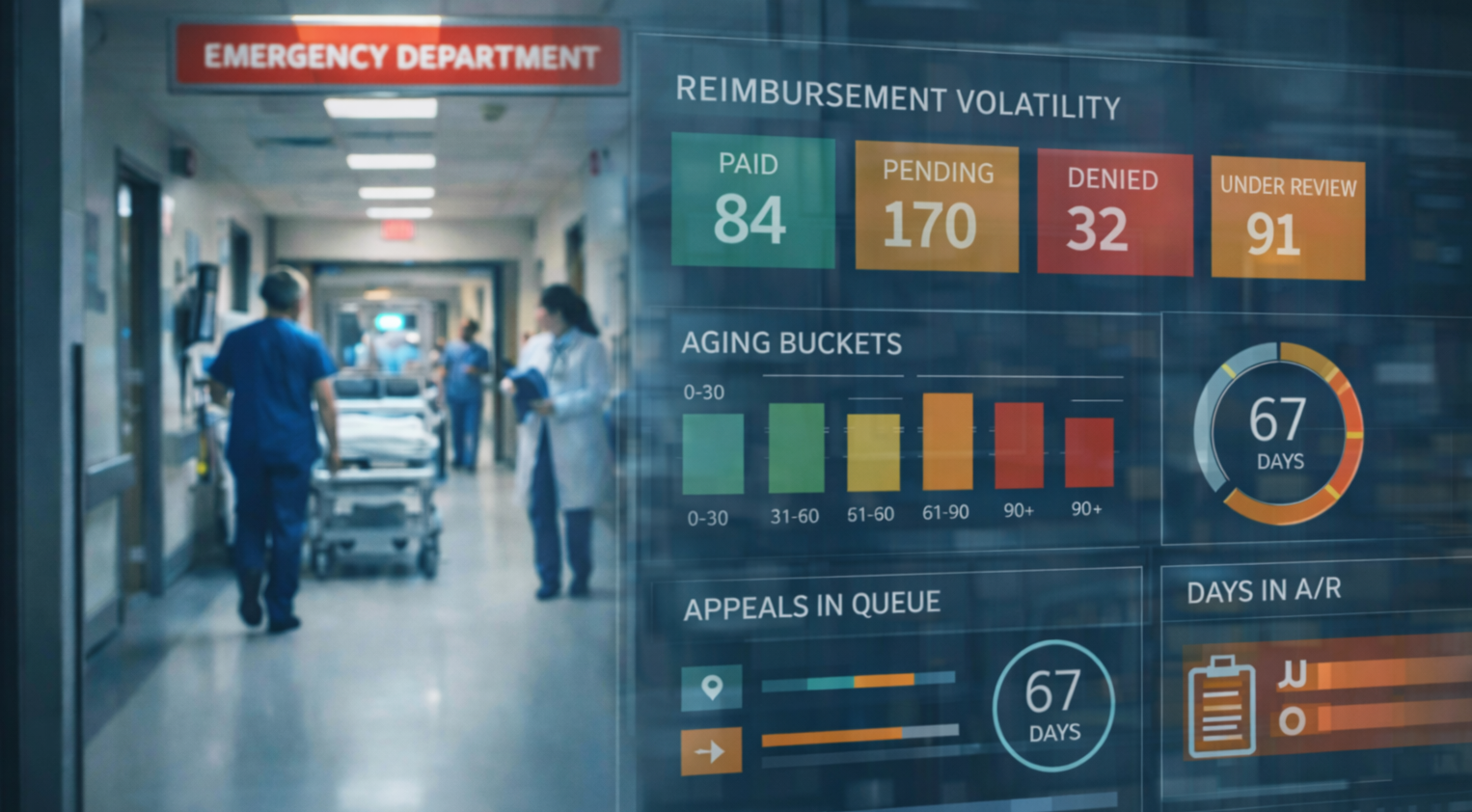
When a critically injured patient arrives in the emergency department, care begins immediately. Trauma teams mobilize. Surgeons are alerted. Blood products are prepared. Imaging is cleared.
There is no pause for eligibility checks or prior authorization.
Emergency medicine is built on readiness — the capacity to respond at full intensity within minutes. That readiness saves lives. It also carries substantial fixed costs.
For hospital executives, however, clinical readiness is only part of the equation. Increasingly, reimbursement uncertainty — particularly payer denials and delayed adjudication — is compounding the already high cost of operating emergency and trauma services.
Understanding both dynamics is essential for sustainable emergency care operations.
The Economics of 24/7 Readiness
Emergency departments function as critical community infrastructure. They cannot scale down during slow periods or defer services when margins tighten.
In 2022, U.S. emergency departments recorded approximately 155.4 million visits, including 43.5 million injury-related visits.1 That volume requires:
- Continuous physician and nursing coverage
- On-call trauma surgeons and anesthesiology
- ICU bed availability
- Immediate access to operating rooms
- Blood bank capacity
- Diagnostic imaging staffed around the clock
These are fixed readiness costs — the price of ensuring that when a patient arrives with internal bleeding, stroke, or respiratory failure, the hospital can act without delay.
Trauma designation adds another layer of obligation. The American College of Surgeons’ trauma verification program evaluates institutional commitment, staffing, resources, policies, and performance improvement systems.2 Maintaining those standards requires sustained investment in personnel, oversight, and data infrastructure.
Emergency readiness resembles fire protection: its value lies in constant availability, not episodic use.
Facility Costs and Emergency Billing Structure
Public scrutiny often centers on emergency department bills. Yet a significant portion of those charges reflect facility overhead rather than individual clinician time.
A Peterson–KFF Health System Tracker analysis of 2019 large employer plan claims found the average emergency department visit cost $2,453, with facility fees accounting for roughly 80% of total visit cost.3
Separately, AHRQ HCUP data estimated 107.4 million treat-and-release ED visits in 2021, with aggregate costs of $80.3 billion, reflecting wages, supplies, and operational expenses — even when patients were not admitted.4
Trauma activation fees illustrate readiness pricing. A study published in JAMA Network Open in January 2023, analyzing 2022 hospital chargemaster data from 523 trauma centers, reported a median tier 1 trauma activation fee of $9,500, with fees ranging from $1,000 to over $61,000.5
Whether stakeholders agree with specific price levels, the underlying premise remains consistent: readiness carries material cost.
Legal Obligations and Uncompensated Risk
Emergency departments operate under the Emergency Medical Treatment and Labor Act (EMTALA), 42 U.S.C. § 1395dd, which requires evaluation and stabilization of patients presenting with emergency medical conditions, regardless of insurance status.6
This statutory framework reflects a public policy commitment to access. It also means hospitals routinely deliver high-cost care without certainty of reimbursement at the time of service.
In a stable payment environment, that risk is manageable. In an environment of rising denials and delayed payment, it becomes financially significant.
The Expanding Impact of Payer Denials
Denial rates have become a central financial pressure point across the healthcare system.
According to Premier, Inc.’s national survey of 516 hospitals — conducted October–December 2023, published March 2024, and analyzing 2022 claims data — approximately 15% of claims submitted to private payers were initially denied, including 15.7% of Medicare Advantage claims and 13.9% of commercial claims.7
The same survey estimated that hospitals and health systems spent $19.7 billion in 2022 on claims adjudication following initial denials.7
In the 2022 data set, more than half of denied claims were ultimately overturned and paid (54.3% for private payers; 51.7% overall). Subsequent Premier survey findings indicate overturn rates approaching 70% in more recent reporting.8 These reversals, however, occur only after multiple rounds of administrative review and appeal.
Payers have cited clinical appropriateness review and cost management as justifications for utilization management practices. However, when denial patterns are systematic and override established medical necessity standards, the question shifts from clinical judgment to contractual and regulatory compliance — an area warranting independent legal evaluation.
For emergency and trauma services, denials frequently involve:
- Retrospective medical necessity determinations
- Downcoding of trauma activation levels
- Documentation-based disputes
- Out-of-network payment disagreements
- Extended adjudication timelines
Because emergency care involves high-acuity, high-cost services, even modest denial rates can materially affect margin performance.
Public Payer Underpayment and Margin Compression
Denials are only one dimension of financial pressure.
According to the American Hospital Association’s cost analysis, Medicare and Medicaid payments fell short of hospital costs by an estimated $100.4 billion combined in 2020, with Medicare covering approximately 84 cents per dollar of spending and Medicaid approximately 88 cents.9 Subsequent AHA analyses have shown these shortfalls continued to grow as labor and supply costs outpaced reimbursement adjustments.10
At the same time, hospital operating expenses rose sharply from 2019 through 2022, while reimbursement growth lagged.10 Many facilities — particularly rural systems — reported negative operating margins.
Emergency departments often function as the front door to these systems, absorbing high-acuity cases across payer types. Financial instability in this service line has enterprise-wide implications.
From Revenue Cycle Issue to Enterprise Risk
For CFOs and General Counsel, payer behavior should not be viewed solely as a billing department concern.
Denial trends influence:
- Cash flow forecasting
- Capital allocation and bond ratings
- Trauma program sustainability
- Managed care negotiation leverage
- Governance and fiduciary oversight
When denial rates increase or adjudication timelines extend, volatility affects enterprise-level financial planning.
At scale, reimbursement instability becomes a governance issue.
Strategic Legal Oversight for Executive Leadership
Operational improvements in documentation and coding remain important. However, recurring denial patterns may warrant structured legal evaluation beyond individual appeals.
Contract Compliance and Enforcement
Managed care agreements define medical necessity standards, adjudication timelines, prompt payment requirements, and dispute resolution mechanisms. Systematic review can identify:
- Pattern-based underpayment
- Misapplication of agreed medical necessity criteria
- Chronic delay beyond statutory or contractual timelines
- Inconsistent interpretation of trauma activation codes
The objective is structural correction — not isolated recovery.
Retrospective Emergency Denials
Emergency coverage decisions are often governed by the prudent layperson standard. Retrospective denials based solely on final diagnoses may conflict with statutory or contractual protections.
Legal analysis can assess whether payer criteria align with governing standards and whether denial practices create contractual or regulatory risk.
Prompt Pay Enforcement
Many states impose statutory timelines for clean claim payment, with interest penalties for late reimbursement. Few organizations systematically quantify or enforce accrued interest across high-volume claims.
From a CFO perspective, prompt pay enforcement is financial stewardship.
Independent Dispute Resolution Strategy
Under the No Surprises Act, out-of-network emergency payment disputes proceed through federal Independent Dispute Resolution (IDR).
IDR outcomes depend heavily on benchmarking, acuity documentation, and structured presentation of market data. Treating IDR as a strategic legal process — rather than a routine administrative filing — can materially affect long-term reimbursement positioning.
Aligning Clinical Readiness with Financial Stability
Emergency and trauma services exist to eliminate hesitation in life-threatening moments.
What has changed is the complexity and unpredictability of reimbursement.
For hospital leadership, the challenge is not merely managing denials claim by claim. It is evaluating whether payer conduct is altering the financial risk profile of emergency operations.
Clinical readiness depends on financial stability. Without predictable reimbursement, sustaining high-level trauma capability becomes increasingly difficult.
Executive-Level Reimbursement Counsel
Emergency and trauma services sit at the intersection of clinical obligation and financial exposure. When payer behavior begins to affect margin stability, cash flow forecasting, or contract performance, the issue moves beyond revenue cycle operations and into enterprise risk management.
Our firm advises hospital CFOs, General Counsel, and executive leadership teams on systemic denial patterns, managed care contract compliance, prompt-pay enforcement, and Independent Dispute Resolution strategy. We focus on identifying structural reimbursement vulnerabilities, quantifying financial exposure, and aligning legal strategy with long-term operational sustainability.
If your organization is evaluating payer performance, denial trend escalation, or reimbursement volatility affecting emergency services, we are available for a confidential executive discussion.
Footnotes
- Centers for Disease Control and Prevention, National Hospital Ambulatory Medical Care Survey (NHAMCS), 2022 Emergency Department Summary Tables, published 2024.
- American College of Surgeons, Trauma Verification, Review, and Consultation Program Overview, accessed 2025.
- Peterson–KFF Health System Tracker, “Emergency Department Visits Exceed Affordability Thresholds for Many Consumers with Private Insurance,” originally published December 2022 (updated July 2024), analyzing 2019 large employer plan claims data.
- Agency for Healthcare Research and Quality (AHRQ), HCUP Statistical Brief #311, “Costs of Treat-and-Release Emergency Department Visits in the United States, 2021,” published 2023.
- Zitek, T. et al., “Assessment of Trauma Team Activation Fees by US Region and Hospital Ownership,” JAMA Network Open, vol. 6, no. 1, January 2023 (analyzing 2022 chargemaster data from 523 trauma centers).
- Emergency Medical Treatment and Labor Act (EMTALA), 42 U.S.C. § 1395dd.
- Premier, Inc., “Trend Alert: Private Payers Retain Profits by Refusing or Delaying Legitimate Medical Claims,” published March 2024 (national survey of 516 hospitals across 36 states, conducted October–December 2023, analyzing 2022 claims data).
- Premier, Inc., “Claims Adjudication Costs Providers $25.7 Billion — $18 Billion Is Potentially Unnecessary Expense,” published February 2025 (national survey of 280 hospitals across 23 states, analyzing 2023 claims data; finding approximately 69% of denied claims ultimately overturned and paid).
- American Hospital Association, “Underpayment by Medicare and Medicaid Fact Sheet,” updated February 2022 (reporting 2020 data from AHA Annual Survey of Hospitals).
- American Hospital Association, “The Cost of Caring: Financial Stability of America’s Hospitals and Health Systems Is at Risk,” April 2023.